
Turnaround time (TAT) is one of the few pathology metrics that every stakeholder in a hospital cares about at once — the pathologist tracking pending cases, the administrator reporting on lab KPIs, the oncologist waiting to start treatment, and the patient waiting for an answer. So it's worth asking plainly: does digital pathology actually move that number, or is "faster diagnosis" just a line in a vendor brochure?
The published data says it moves — consistently, and by a meaningful margin.
A 2025 observational study out of Clínica Universidad de Navarra compared nearly 12,000 biopsy cases before and after a shift to digital pathology, and found mean turnaround time dropped from 10.58 days under conventional microscopy to 6.86 days digitally — a statistically significant reduction of 3.72 days per case. The same study found the lab's backlog of pending cases fell by roughly 25 on average annually, with reductions of up to 100 cases during peak workload months.
That's not an isolated result. A study at Memorial Sloan Kettering found a 25% reduction in turnaround time for surgical resection cases where pathologists had prior whole slide images on hand for comparison. A 2019 study in the Journal of Pathology Informatics similarly reported 20–30% turnaround time reductions after digital implementation. And in telepathology specifically — where the win is less about scanning speed and more about eliminating physical transport — case studies across cloud-based networks and international consultation programs have shown reductions ranging from 30% to 67%, with diagnostic accuracy holding above 98%.
Perhaps the most striking figure comes from a hematopathology teleconsultation program between a U.S. academic center and a hospital in Vietnam: average turnaround time fell from 7 days to 5 — a 30% improvement — simply by replacing physical slide shipping with whole slide image review.
It helps to break "faster diagnosis" into its actual components, because digitization doesn't save time in one place — it removes friction from several:
Courier runs between labs, satellite sites, or subspecialist consultants are often the single largest contributor to TAT — one documented case saw a step drop from 86 hours to 35 minutes purely by replacing shipping with digital transfer. A high-throughput scanner turns that transport time into a file transfer.
A case that used to wait days for a courier to reach the right expert can now reach that same expert — anywhere — in the time it takes to open a telepathology link.
When a pathologist can pull up a patient's prior WSIs directly rather than requesting archived glass slides, comparison-dependent cases resolve faster, as the Sloan Kettering data reflects.
Because digital cases move through the system faster individually, they also accumulate less — which is why the Navarra study saw pending case counts drop, not just per-case TAT.
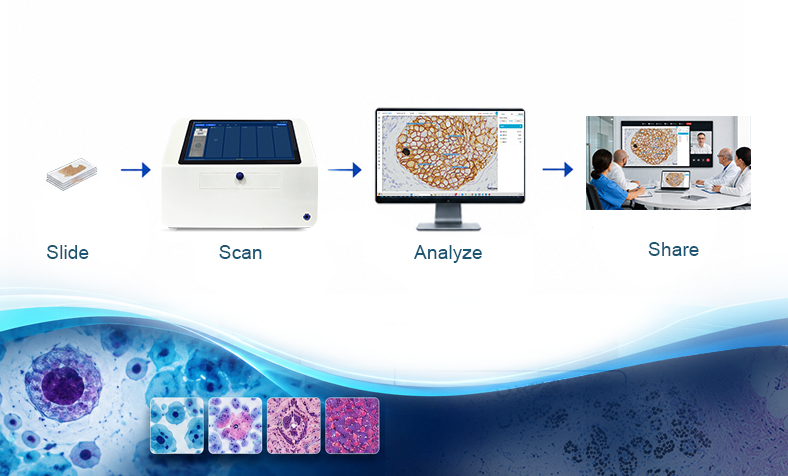
None of these gains happen from owning a scanner alone — they come from a workflow where scanning, image management, and remote access are actually connected. OptraSCAN's approach reflects that structure directly:
It's worth noting that digitization isn't purely additive time savings — scanning itself adds a small amount of time to the front end of a case (some studies note workflows running a few percentage points longer between accession and "slides ready"). The net gain comes from what happens after that point: less handling, less shipping, faster access, faster comparison. For labs weighing whether digitization is worth it purely on a TAT basis, the published evidence is fairly consistent that it is — the gains downstream outweigh the modest cost upfront.
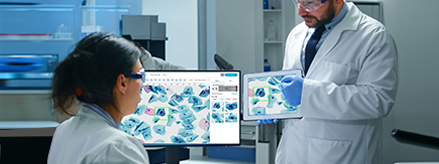
Improving diagnostic outcomes through digital workflow adoption.

Everything you need to know about digitizing histopathology workflows.
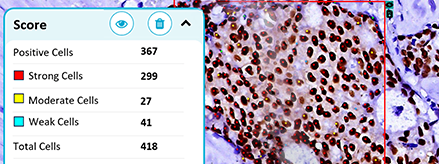
Where AI stands today and what's needed to close the gap.