
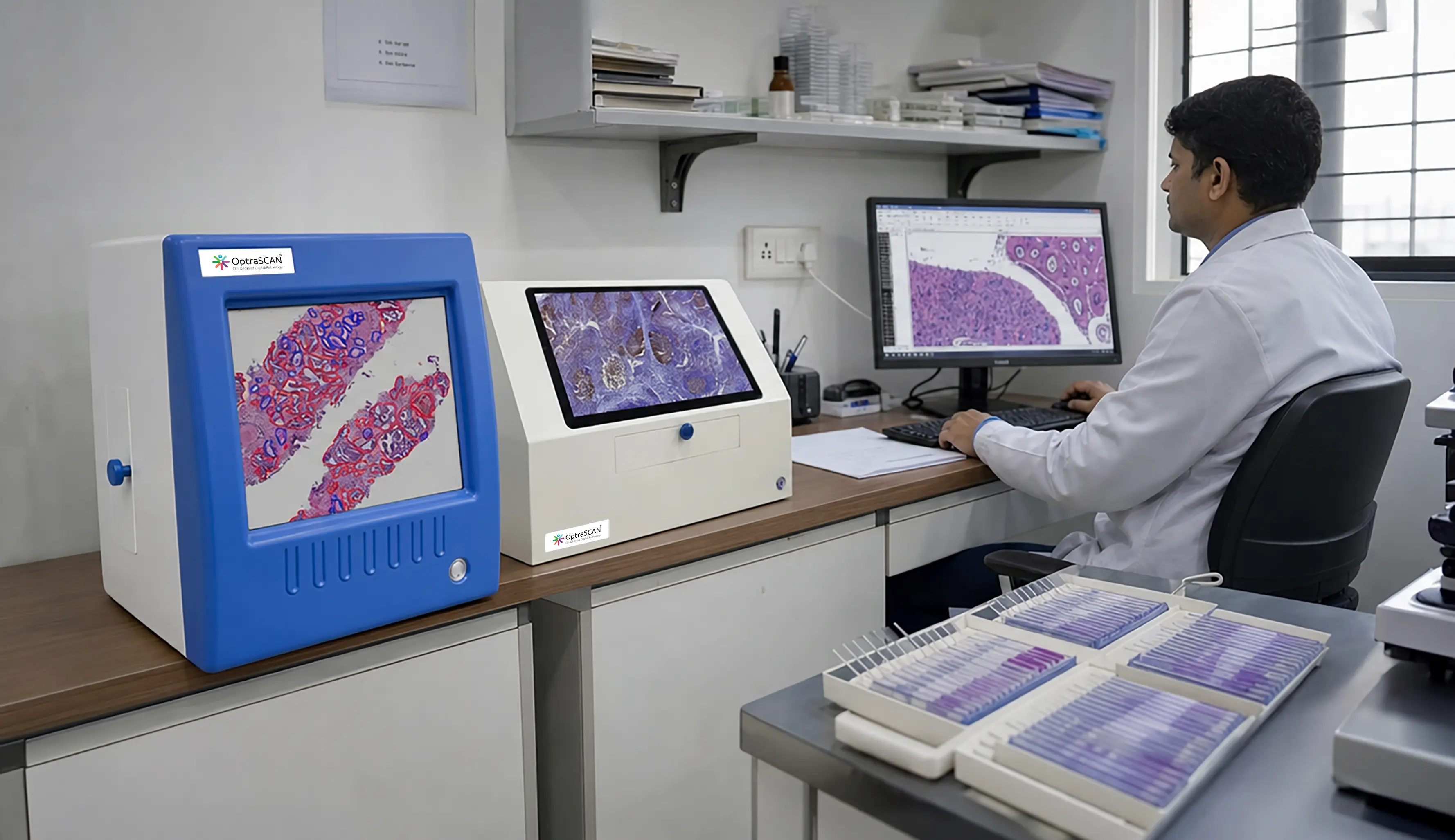
For a long time, the honest answer to "should our small lab go digital" was "not yet, not at this price." Whole slide scanners were built and priced for high-volume reference labs and academic centers, and a six-figure capital outlay made no sense for a lab running a fraction of that case volume. That math has genuinely changed. Digital pathology has a lower entry tier now — smaller scanners, cloud-based software, and pay-as-you-go pricing models built specifically for labs that don't (and won't) scan thousands of slides a day.
If your lab has been sitting out the digital transition because of cost, here's what's actually changed, and what the on-ramp looks like now.
The biggest affordability shift isn't really about hardware getting cheaper, though it has — it's about labs no longer being forced into a capital purchase at all. Pay-per-scan and OPEX-based models let a lab access scanning hardware and software without a large upfront investment, converting digital pathology from a capital expenditure into an operating cost that scales with actual case volume. For a lab running lower or seasonal volumes, that's the difference between "we can't justify this" and "we're only paying for what we use."
This matters because the traditional math against digitizing was never really about whether digital pathology worked — it was about whether a lab's volume justified the fixed cost of the equipment. Flexible, volume-based pricing removes that constraint by design.
The second shift is that scanners built for small labs are now genuinely built for small labs, not scaled-down versions of enterprise equipment. OptraSCAN's compact lineup illustrates this well:
Both integrate with the same cloud-enabled software backbone as OptraSCAN's higher-throughput scanners — IMAGEPath for image management, storage, and archival, and TELEPath for telepathology and remote consultation — so a smaller lab isn't locked out of the collaboration and remote-access benefits that used to require enterprise-scale equipment.
Cost isn't the only thing smaller labs have historically sacrificed by staying analog — it's also access. A smaller lab is statistically less likely to have every subspecialist in-house. Cloud-enabled telepathology gives a small lab the same remote consultation reach as a much larger one, without needing to hire (or fly in) a specialist. That's arguably as valuable as the cost savings themselves: a compact scanner paired with telepathology software effectively borrows a large lab's subspecialist bench for the cases that need it.
For a lab weighing this for the first time, it helps to separate two questions that often get conflated:
With entry-level scanners like OS-SiX and OS-Lite, and pay-per-scan pricing removing the capital purchase requirement, the answer for most labs today is genuinely yes.
This is the more useful question, and it's volume- and workflow-specific — a lab running mostly routine H&E cases with occasional subspecialist referrals gets a different return than one juggling frozen sections or high IHC volume.
Because the newer pricing models scale with usage rather than requiring a fixed bet upfront, a lab can test question 2 without needing to fully answer question 1 in advance — start on a smaller scanner and flexible plan, and let real usage data determine whether stepping up to higher-throughput equipment makes sense later.
Affordability in digital pathology used to mean choosing the cheapest version of an enterprise system. Now it means choosing hardware and pricing actually built for a lab's real volume — and OptraSCAN's compact scanners paired with flexible, pay-per-scan deployment are built around exactly that principle: don't make a small lab pay for capacity, or commit to costs, it doesn't need.
Improving diagnostic outcomes through digital workflow adoption.

Everything you need to know about digitizing histopathology workflows.
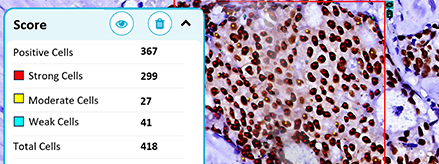
Where AI stands today and what's needed to close the gap.