
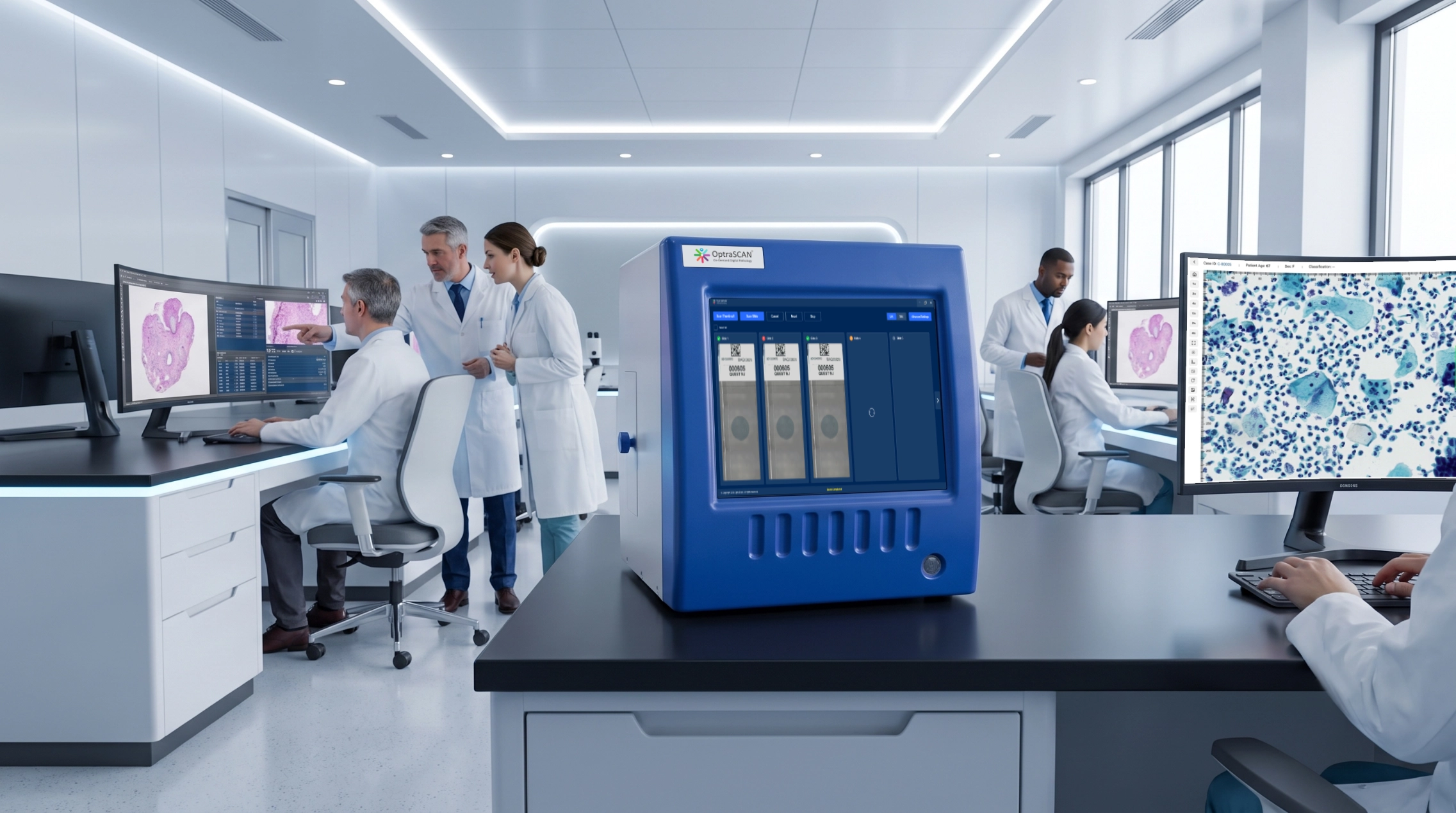
Most digital pathology purchase decisions get evaluated one component at a time: which scanner has the best throughput, which software has the cleanest viewer, which AI tool has the strongest validation data. What gets underweighted — until it becomes a problem — is whether any of those pieces will actually talk to each other, or to the systems already running in your lab. Interoperability isn't a feature on a spec sheet. It's the difference between a digital pathology investment that compounds in value over time and one that quietly becomes a walled-off island next to everything else your lab runs.
Digital pathology has a structural interoperability challenge that fields like radiology largely solved years ago. A typical lab's ecosystem often involves one vendor for scanners, another for the LIS or EMR, and potentially a third for AI-based image analysis — and unlike radiology, pathology still relies heavily on proprietary image formats that differ from one scanner manufacturer to the next. Without a shared standard, integrating across that stack becomes custom engineering work rather than plug-and-play, which is exactly what drives up implementation cost, timeline, and risk.
DICOM — the imaging standard radiology has used for decades — is being extended to pathology through DICOM Supplement 145 and the DPA's Working Group 26, and momentum is building. But adoption across vendors is still inconsistent: some support only partial DICOM implementations, and others keep pushing proprietary formats that lock labs into a single ecosystem. For a lab making a purchasing decision today, waiting for the standard to fully mature everywhere isn't realistic — which is why vendor-neutral practices matter as much as the standard itself.
The practical costs of poor interoperability show up in a few predictable places:
An interoperable digital pathology setup generally means three things are true simultaneously: the image management platform can ingest formats and scanners from more than one manufacturer, it integrates natively with the LIS/HIS already in place rather than requiring a separate parallel record, and it stays open to third-party AI tools instead of restricting analysis to a single proprietary suite.
OptraSCAN's approach to this is built around IMAGEPath, its image management system, which is designed as an open platform — able to integrate with scanners from multiple manufacturers and more than 20 different image formats, while remaining compatible with third-party AI applications rather than requiring labs to use only OptraSCAN's own analysis tools. IMAGEPath also supports full LIS/EMR integration, so accession and patient data move with the case rather than living in a separate silo, and it's built to work across single-site labs and multi-site enterprise networks without requiring a different platform at each scale.
This orientation shows up in OptraSCAN's own partnerships: a collaboration with Paige to integrate Paige's clinical AI applications and interoperable imaging platform with OptraSCAN's scanners, and a partnership with Lumea, whose Lumea+ platform is built to integrate with any LIS alongside a marketplace of AI, scanner, and genetic-testing partners. Neither partnership would make sense if OptraSCAN's platform weren't genuinely open to begin with — a closed system doesn't attract multi-vendor integrations.
For a lab or health system evaluating a digital pathology platform, a few interoperability questions are worth asking before any hardware or software purchase, not after:
A platform that answers all four cleanly is built for the way digital pathology ecosystems actually evolve — multiple vendors, growing case volumes, and AI tools that didn't exist when the original purchase was made.
Improving diagnostic outcomes through digital workflow adoption.

Everything you need to know about digitizing histopathology workflows.
Where AI stands today and what's needed to close the gap.