
Ask a room of practicing pathologists whether AI is coming for their job, and you'll get more eye-rolling than anxiety. It's not that they dismiss AI — most have already used it in some form. It's that the question "will AI replace pathologists" gets asked by people outside the field far more often than by the people actually doing the work, and the two groups tend to be answering different questions. One is asking about jobs. The other is asking about diagnosis. The real answer only makes sense once you separate them.
No — not in any near-term clinical reality, and not for reasons that are likely to change soon. What's actually happening is a shift in how pathology work gets done, not a removal of the pathologist from that work. Legislative, ethical, and clinical accountability structures all currently require a licensed pathologist to sign out a diagnosis; an algorithm can flag, score, and prioritize, but it cannot take on the legal and clinical responsibility that comes with a diagnosis. That's not a temporary technical gap — it's a structural one, tied to how medicine assigns responsibility for patient outcomes.
AI in pathology has moved from experimental to genuinely practical over the past several years — slide triage, mitotic figure counting, biomarker quantification, and pattern detection across whole slide images are all live use cases today, not hypotheticals. That's real, meaningful progress, and it's exactly why the replacement question keeps getting raised. But adoption of AI-assisted pathology tools has consistently followed the same pattern seen elsewhere in diagnostic medicine: algorithms take on narrow, repetitive, or high-consistency tasks, while pathologists retain the parts of the job that require full clinical context — patient history, differential diagnosis, and judgment calls that don't reduce to pattern recognition.
Where AI pathology diagnosis tools genuinely help is in the parts of the workload that create burnout and bottlenecks: pre-screening slides so urgent cases surface faster, reducing repetitive scoring tasks like IHC intensity grading, and improving consistency in high-volume practice where fatigue is a real factor for humans and isn't one for a well-validated algorithm. None of that requires — or is aiming for — removing the pathologist from the loop. If anything, it's aimed at giving an already overburdened workforce more capacity, at a time when rising case volumes and pathologist shortages are a documented, ongoing strain on the field.
The systems getting real clinical traction share a pattern: they're integrated into a pathologist's existing digital workflow, not positioned as a standalone replacement for review. A tool that flags a suspicious region still hands that region to a pathologist for interpretation in clinical context. A tool that scores HER2 or Ki-67 expression still produces a result a pathologist reviews and signs out, not one that bypasses them.
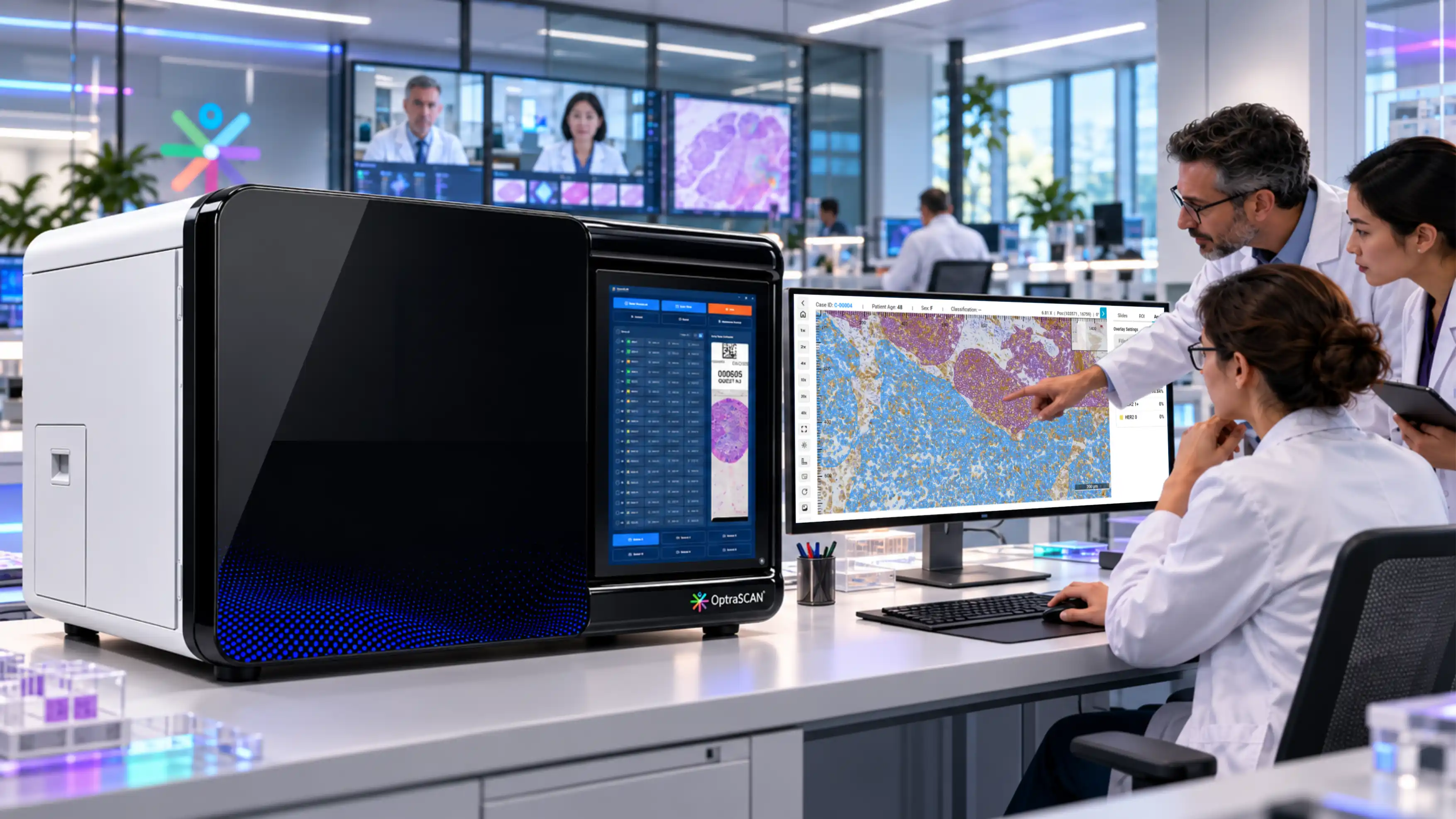
OptraSCAN's approach reflects that same principle. Its OS-SiA™ platform is built on patented technology that scans and analyzes a slide at the same time, rather than treating scanning and analysis as separate steps — detecting tumor foci, mitotic figures, and immune infiltrates as the slide is being digitized, and producing reproducible, standardized scores for biomarkers like HER2, ER, PR, Ki-67, and EGFR that are validated across institutions and scanners. This is built around an assistive model rather than an autonomous one: the value proposition isn't "the algorithm replaces the read" — it's consistency and speed on the quantitative, repetitive parts of the job, so the pathologist's time goes toward the interpretive work AI genuinely can't do.
The honest version of this shift isn't "nothing changes." Pathologists working alongside AI-assisted pathology tools are increasingly expected to know how to evaluate an algorithm's output, understand its failure modes, and know when to override it — a real, if evolving, addition to the job description. Departments considering AI-ready platforms are also having to think about workflow integration, validation, and audit trails in ways that didn't exist a decade ago. That's a genuine shift in how the job is done. It's not the same thing as the job disappearing.
Will AI replace pathologists? Based on where the technology, the clinical accountability structures, and the field's own adoption patterns currently stand, the answer is no — and the more useful question for a lab or health system to be asking isn't whether to hold AI at arm's length out of concern for the profession, but which AI-assisted pathology tools actually integrate cleanly into a pathologist's existing workflow, versus which ones are solving a narrower problem than the marketing suggests.
Improving diagnostic outcomes through digital workflow adoption.
Everything you need to know about digitizing histopathology workflows.
Where AI stands today and what's needed to close the gap.